Tuesday, March 29, 2011

Joseph Beuys - Influential and Craziness all in one Package


You know, I'm starting to understand just how much Santi loves showing off all of these crazy artists. Needless to say the last few classes have been intense. Anyways, we recently learned about this German artist by the name of Joseph Beuys, and let me tell you, Orlan has nothing on this guy when it comes to craziness. Beuys grew up around the time the infamous Third Reich came to power. Upon graduating school in 1941 he joined the German air force and was an airplane radio operator for them until the end of the war in 1945. It wasn't until after the war that he really used his artistic talents. For more biographical info on Beuys, I found this website to be pretty informative.

Now on to Beuys' artwork. Beuys work was known for its shock value, and for its unpredictability. Beuys mainly focused his works on humaism and social philosophy. His most famous work was a performance piece, and believe it or not one of his first pieces altogether, known as How to Explain Pictures to a Dead Hare, and yes a dead hare was actually used for this piece. Beuys would lock himself inside a glass chamber with a dead hare, which meant that the audience would only be able to view him form the outside. Beuys would then have an animated conversation with the dead hare, none of which the audience could hear. Literally, the audience would watch him talk animatedly to a dead hare, and not even know what he was saying. The reason I know this piece was so influential is because despite its gruesome nature, it is one of my favorite pieces of his, and I can't get the images of it out of my head. Beuys made many more works that had a profound impact on art in the 20th century, and he became one of the most influential artist of his time. Here is a really good website I found that has more of Beuys' works


Orlan - One of the Craziest Artists I've Ever Seen


Mireille Suzanne Francette Porte, or Orlan, as she is most commonly known, is a french artist who lives and works in LA, New York, and Paris. She creates all sorts of works; videos, sculptures, installations, and even performance art. You name it, and Orlan has probably done it. She is best known however, for her work with plastic surgery in the 1990s. The project, known as The Reincarnation of Saint Orlan, began in 1990 and is still ongoing today. Essentially, Orlan is undergoing a series of plastic surgeries that will allow her to acquire the ideal form of female beauty as seen in the paintings of male artsits. One such part for example, si the forehead of DaVinci's Mona Lisa.

Having looked at some of Orlan's other work, which can be found here, I must say that she is by far one of the craziest artists I've ever seen. However, as I am slowly learning from Santi, the crazier you are as an artist the better. I actually really like Orlan's work. I can tell by looking at it that she really knows how to send a message with her pieces. At any rate, here are a few of her pieces, and of course, you can find these and more on her website.


Tuesday, March 22, 2011

Grid Project

In the midst of studying computer art and the origins of computers, we had to do a Grid Art project for Art 211. Naturally, the idea was to emulate the computers use of pixels by using a grid to create a piece of art. I chose to use perlor beads for my project. Perlor beads, are those beads you put on a little bead plate and then iron together to make all sorts of crazy designs and shapes. For my project I took a picture of myself using the webcam on my macbook and then printed it out and drew a grid on it. I used the printed photo as a map to create the piece pictured below. Unfortunately it didn't really come out to look like me, but it still looks really cool, so I'm happy. Anyways, that's one more project in the books, and only 3 more to go!!!!!

Wednesday, March 16, 2011

Interactive Art: Breaking the 4th Wall


When we go to an art gallery, say Le Louvre, we mostly imagine ourselves walking through various hallways and roms looking at paintings and sculptures. For hours. With no breaks. Unless you're a huge art fanatic, that might get boring pretty quickly. However, in the early 20th century, a movement began to try to involve the user in the artwork, or in other words, to break the 4th wall. This movement, called Interactive Art, brought forth all sorts of wacky and innovative sculptures and other works of art that, in one way or another, attempted to involve the user, most very successfully.

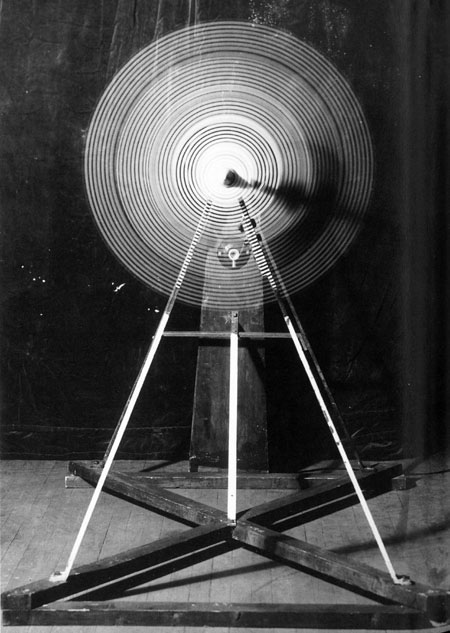
One of the most famous of these pieces is the Rotary Glass Plates by Marcel Duchamp. The piece was made in 1920, and essentially, it was a bunch of glass plates on a wheel. The user would spin the wheel and then stand one meter away. The effect of this can be seen in the photo provided, but needless to say the user was involved and was rewarded with an amazing sight. Duchamp revolutionized the art world with his piece and the Interactive Art movement grew immensely because of him. This website has more information on Interactive Art as well as Marcel Duchamp.

Tuesday, March 1, 2011

Flip Book Animation

So the flip book animation project is finally done. I have to say, I actually had fun doing this project. But be warned, making flip book animations requires a lot of tedious work. There were many times while I was working on this project that I wanted to just burn my book and be done. However I kept persevering, and now I have an awesome animation, and a good grade to go with it ;) Anyways, here arre some pics from it, enjoy!!!!


Thursday, February 24, 2011

Computers, what would we do without them?

Ahhh finally a topic for one these blog posts that I can actually relate to. As I'm sure is general knowledge by now, computers are awesome. They allow us to do so many things we couldn't do before, and even do something better than we used to. From software like Photoshop, to simple things such as viewing tv shows and movies, computers have a permanent place in our society because they are just so damn useful. The federal government figured that out a long time ago when it used a mechanical counting system to tabulate the US Census. That machine got the job done in a few weeks whereas before it took years to complete. What we need to be aware of however, is that computers were not always as powerful as they are today.

Originally, computers were used for minute taks such as counting and making various other calculations. On top of Census Tabulation, the first real computers were used to generate military firing charts (calculations that allowed the military to know how far their projectiles would go when they launched them). The personal computer didn't come about until the mid 1970s. Now here's the crazy part; today we all know Microsoft and Apple as the big computer moguls. Well the crazy thing is, neither one of those companies developed the first personal computer. In fact, they copied the technology from its original creator. In 1974, Xerox, (no you're not reading that wrong) the company that made you a copy of that business report this morning, created the Xerox PARC Alto, the world's first personal computer. The only problem was, the Xerox execs didn't think the technology would go anywhere; so when Steve Jobs, among other tech junkies, visited the Xerox lab, they sold the technology to them. The Apple1 is a complete ripoff of the Xerox PARC Alto.

Now don't let this post fool you, I'm not hating on apple as I'm sitting here typing on my 15 inch Macbook Pro, but it should be noted that the people we generally give our hard earned money to are selling us the fruits of someone else's labor. From that point on, personal computers would continue to evolve into the computers we know today. This article on TechNewsDaily shows some of the steps the personal computer took along its long and winding journey to its current state.

Watson: Future Skynet? or Man's Greatest Creation?


In mid february, IBM stunned the world, by creating a machine capable of understanding human language, and competing on game shjows alongside humans. I am talking about of Course, IBM's computer system known as Watson, and its appearance on the "Jeopardy!". Watson competed against two "Jeopardy!" greats, Ken Jennings, the man who won 74 consecutive games, and Brad Rutter, who won has won the most money from the show. Watson stunned the world when it not only won, but blew away the competition. Watson showed off its computing brilliance with a gusto, and but us humans to shame. Watson operates on a database that takes up an entire room, and contains 15 terabytes (I only wish my computer had that much memory...) of memory space.

As we move into an era where machines are becoming more and more integrated into our society, we have to wonder, will machines ever overtake humanity? While we probably won't have to worry about Watson becoming Skynet and leading a revolution of machines against humans, we should all be aware that as we build computers that are more and more intelligent, and we integrate them into everything, we risk them figuring out how to take off their proverbial leashes, and becoming self-sufficient. While Watson will allow us to create many extremely useful technologies; I hear IBM is already beginning work on a physician's assistant for medical schools and physicians everywhere; we also need to be aware of our limits and avoid bringing about our own demise.